Why I Kept the Hotel Management System and Restaurant POS as Separate Products
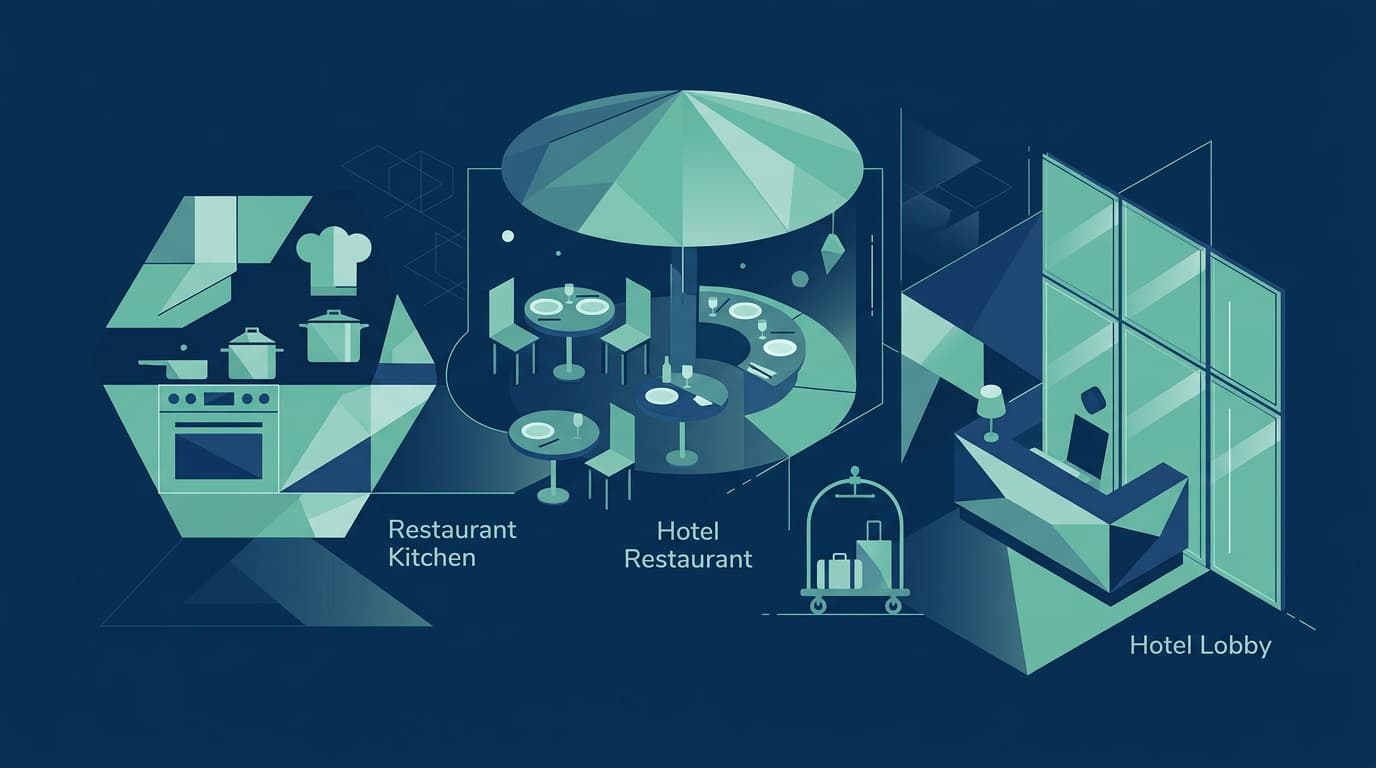
Hook
The easier path was sitting right there: I already had a working restaurant POS, and a hotel needs a restaurant too. Just add rooms, add bookings, ship it as one bigger system. I didn't take that path, and the reasoning is worth writing down, because the pressure to merge two products that look adjacent doesn't go away just because you resisted it once.
The Problem
A restaurant POS and a hotel management system look similar from a distance, both take orders or bookings, track payments, manage staff access, and report to an owner. But the businesses underneath run on different logic. A restaurant's core unit of work is a table turning over an order in minutes. A hotel's core unit of work is a room occupied across nights, with check-in and check-out states and rate calendars a restaurant has no equivalent for. Force both into one data model and one of them ends up modeled as an awkward special case of the other.
The Argument
I kept them separate because the cost of a shared, over-general system shows up later, and it's more expensive than the cost of building two focused systems now. A combined product needs a data model flexible enough to represent both a table order and a multi-night room booking under some shared abstraction, a generic "reservation" entity, say. That sounds elegant on a whiteboard. In practice it means every feature built for one domain has to be checked against whether it breaks the other, and every schema change risks a use case it wasn't designed for.
That's the textbook cost of premature generalization, you pay a permanent complexity tax to support a unification nobody explicitly asked for. Keeping the systems separate let each one stay simple enough to actually match how that specific business runs, which is the principle I keep coming back to across every build: understand how people actually operate before you design the software, not how a unified abstraction would prefer they operate.
This isn't an argument for total isolation, either. The restaurant POS was piloted inside an actual hotel's in-house restaurant, so the two systems still need to share some things, reporting rolled up to one owner, shared staff accounts. The right way to handle that is integration at the edges, not a shared core model. Keep each system's internal logic honest to its own domain, and connect them where the business actually needs one view.
Key Takeaways
The honest counterargument is development cost. Two products mean two codebases, two onboarding flows, two things to maintain, real overhead for a small team. If hotel-with-restaurant customers turn out to be the dominant segment rather than the exception, a single combined product might reduce their setup friction enough to be worth reconsidering. That's the one place I'd revisit this call, when the customer data says so, not before.
Bright Bediako
Volunteer and Mentor @ Barcamp Takoradi and Junior Camp Ghana.